
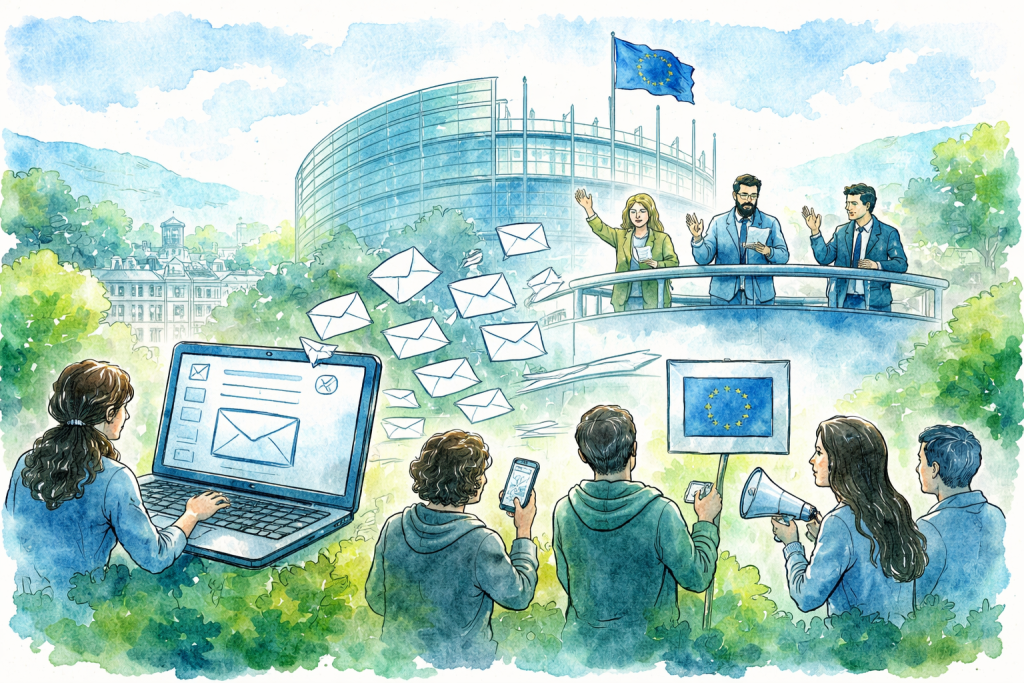
Last month, Members of the European Parliament received an internal email that caught the attention of many campaigners. In short, it said this: campaign emails from citizens are becoming a problem – we need to silence them.
“Since the beginning of this Legislative term, the number and recurrence of mass email campaigns addressed to Members has grown exponentially, causing important disruption to the daily work of Members and Assistants.
[…] DG ITEC is working on a flagging system that will tag incoming emails at server level based on their volume, frequency, and specific characteristics […] this will enable all tagged emails, even belonging to different campaigns, to automatically move as they arrive, from your Inbox to specific folders in your mailbox or Online Archive“
As civil society, we’ve done so well at engaging Europeans in letter writing campaigns, we’re now going to pay for our success. To deal with the “problem” of too many citizen emails, the Parliament’s IT department is developing a global system that will automatically tag these emails, to remove them from the inbox into the archive, never to be looked at again.
In other words: the EU institutions chose to use European taxpayer money to put in place a technical system to filter out citizens legitimately contacting their elected representatives. On purpose.
Email is one of the last channels for voters to get in touch with politicians. But is hearing about issues that people care about an inconvenience to the MEPs?
Let’s call this what it is: disgraceful, disrespectful to European citizens, and in direct opposition to the principles of parliamentary democracy.
Yes, inbox overload is real
Let’s start with the obvious: the problem of inbox overload is real. MEPs receive huge volumes of email. Not only through mass email-to-target campaign actions, but also from lobbyists, institutions, journalists, and colleagues.
When a campaign mobilises thousands of supporters, those emails arrive all at once. Assistants have to read, sort, and decide what to do with them. It can be time-consuming. So it’s understandable that Parliament staff are looking for ways to manage this better.
But the proposed solution – automatically tagging and filtering campaign emails – completely misses the point. Those emails are not spam: they’re citizens participating in democracy. The European Union needs more of those, not fewer.
The last direct channel, gone?
For many citizens, writing to their representatives is already difficult. The EU can feel distant. Most people don’t personally know their MEP and have no clue how the European Parliament works.
Civil society organisations who run message-to-target campaigns are the real connective tissue of European democracy. They build bridges between citizens and decision-makers in the European Parliament by educating, flagging when issues come up, and giving people a simple way to tell their representative: “This issue matters to me. Please act.”
If those messages are automatically filtered or buried in folders, one of the last accessible channels between citizens and EU decision-makers disappears.
This is particularly ironic at a time when everyone agrees that democracy in Europe needs stronger citizen participation, but the EU response risks doing the opposite. It also wastes public resources. Instead of improving dialogue between citizens and representatives, the IT team is designing systems that block democratic participation more efficiently.
Our solution (for now): a state-of-the-art message-to-target
At Proca, we’ve spent years working with hundreds of NGOs across Europe on campaigns targeting MEPs. And we’ve also worked with MEPs and parliamentary groups themselves (those who DO want to keep hearing from their constituents), trying to understand how they actually deal with incoming messages.
One thing is clear: the technical side matters. If thousands of identical emails arrive at the same time, mail servers react. Campaigners need to be aware of that: the goal isn’t to overwhelm systems, but to deliver meaningful signals from citizens in ways that are readable and useful for politicians.
Our Message-to-Target (MTT) tool includes several features designed to do exactly that.
1. Message variation with the Snowflake Engine
Spam filters are very good at detecting thousands of identical messages offered to supporters as template emails. But regular people might not feel confident enough to write a message about policy demands all on their own. That’s where Proca’s Snowflake Engine comes in.
Instead of sending one standard template email, the system can automatically generate thousands of unique variations of a message. Supporters are also encouraged to customise the message in their own voice. So the core demand remains the same, but wording and structure change across versions to avoid inbox filters and make the message feel more authentic.
Read more about the Snowflake Engine here. Or check our this post about How To Write A Great Message To Target.
2. Drip delivery instead of email floods
Another common issue is timing. Traditional digital action tools send emails immediately after a supporter hits “send”. If thousands of people take action on the same day, e.g. when the campaign first launches, thousands of emails arrive within minutes.
Proca’s drip delivery approach solves this by queuing emails and sending them over time rather than all at once. MEP offices still receive the same number of messages, but in a steady flow rather than a sudden flood.
3. Daily digests instead of hundreds of separate emails
Another option is the message digest approach. Instead of sending every email individually, Proca can compile them into daily (or weekly) summaries delivered to the target.
A digest might include:
- A short summary of the campaign demand
- The total number of messages sent since last digest, and since campaign launch
- Geographic breakdowns (for example: how many people wrote from each country)
- A selection of real supporter messages or comments
This gives MEP offices a clear overview of citizen engagement and support for an issue, without overwhelming their inboxes, in a structured format that is easier to process.
4. Supporter-sent emails
Instead of sending all campaign emails from a single campaign server, Proca can send messages directly from the supporter’s own email client. We still record the action, so campaigners can track participation and shares.
From the perspective of the recipient, the message comes from a real individual address, not from a centralised campaign system. This reduces the likelihood of server-level filtering, and feels more like an authentic message from a citizen. However, this also means we can no longer do drip delivery or digests. We’re ready with this solution – but it’s more of a stop-gap measure rather than a long term answer to the problem.
Our vision (long-term): Circular Democracy
Technical workarounds can let you keep sending emails – in the short term, we can adapt our tools faster than they can block us. But with every new workaround, the crucial campaigning work we do gets disrupted, and we still don’t have an answer to the bigger question: should citizen participation depend on outsmarting spam filters? Why are we forced into a tech race just to have our voices heard? Is this the kind of democracy we want for Europe?
We think not. That’s why we’ve also been thinking about a longer-term solution. We call it Circular Democracy, and since mid-2025 we’ve been working on the concept with partner NGOs and the few MEP offices who are keen on hearing from European citizens.
Right now, political communication between citizens and EU institutions is fragmented. Circular Democracy tries to connect those pieces into one coherent system. The goal is simple: create a better, two-way communication channel between citizens and decision-makers.
Instead of receiving thousands of mass emails, representatives would have a dedicated interface for constituent engagement. It would allow politicians to see citizen engagement more clearly and in real time. And it would let citizens see how their voices influence decisions because they receive feedback from their elected officials. It turns participation from a flood of messages into an ongoing conversation.
Citizens & CSOs take active part in shaping policy
When CSOs launch campaigns, citizens could express support through the well-known, effective message-to-target tool. But instead of sifting through thousands of emails, MEPs could use the dedicated platform to easily see how many constituents care about the issue and what their concerns are. Participation remains visible, but the information is organised in ways that are easier for political offices to process.
Civil society would still play a central role. Campaign organisations remain essential in this model – as in any well-functioning democracy. But instead of acting only as email intermediaries, they become part of a structured democratic feedback loop.
Representatives could respond
Right now, when someone writes an MTT to an MEP, the interaction is usually one-way. Replies are rare. Circular Democracy aims to make the communication two-way, allowing politicians to actually respond to citizen concerns.
MEPs could:
- acknowledge citizen concerns
- publish their responses to campaign demands
- indicate whether they support or oppose specific demands and why
- provide updates as legislation moves forward
Citizens wouldn’t just send messages into a void. They would see how their representatives react.
Fix, don’t filter
The email sent to MEPs last month highlights a real tension. Citizens want to be heard but feel more and more disconnected from European-level decision making. MEPs are overwhelmed and fail at listening to the concerns of those who elected them. Technology sits in the middle.
Filtering campaign emails may make inboxes cleaner. But it doesn’t fix the democratic problem. The real challenge is designing systems that allow mass participation without overwhelming decision-makers.
That’s what we’re trying to do at Proca. In the short term, better campaign tools can help keep citizen voices visible. In the long term, we need something bigger: new infrastructure for democratic communication.
Because democracy shouldn’t depend on whether an email passes a spam filter. It should depend on whether representatives are willing – and able – to listen to the people they’re meant to speak for.